After years of being a service provider, working as an Integrator, hiring other service providers, working alongside business owners, and now coaching other Integrators, I’ve accumulated quite a few opinions about the online service provider industry, and some of them might be a little controversial.
There are so many things we’ve accepted as the way you’re supposed to build a service-based business. Charge this way. Set these boundaries. Market yourself here. Follow this strategy.
But just because something has become standard advice doesn’t mean it’s the right advice for you.
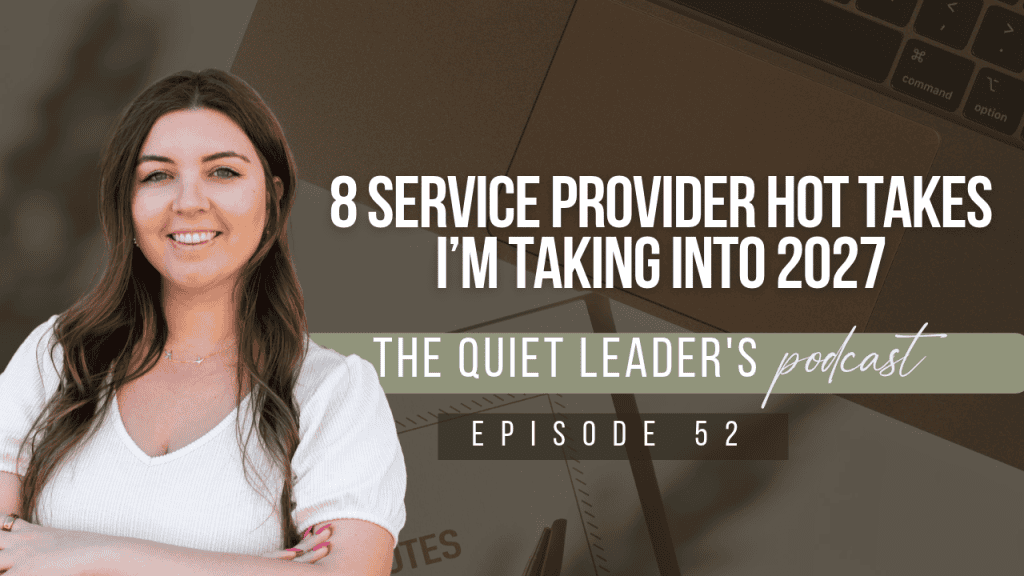
So, as we head toward 2027, here are eight service provider hot takes I think are worth talking about.
1. Hourly Pricing Shouldn’t Be the Goal
I’m not saying there’s never a place for hourly work. But as you become more experienced and move into a higher-level role, I don’t believe your income should be directly tied to how long something takes you.
Think about what happens as you get better at your job.
Something that used to take four hours might take you one. You build templates. You create systems. You learn your client’s business. You know how to use AI. You know exactly what questions to ask.
Why should becoming better at your job mean getting paid less?
It shouldn’t.
Your client isn’t only paying for the hour it took you to complete something. They’re paying for the years of experience that allowed you to complete it in an hour.
This is why I’m such a huge believer in retainers. My clients retain me for the role I play inside their business, the areas I’m responsible for, and the outcomes we’re working toward.
Your value is not your time.
2. We’ve Gone a Little Too Far With Client Boundaries
Let me be clear… you should have boundaries with your clients.
But sometimes the advice around boundaries starts to sound like this:
Don’t answer after a specific time. Never do anything without a certain amount of notice. Don’t respond too quickly or they’ll expect it. Never make exceptions.
At some point, I have to ask: Do you even like your clients?
Sometimes what we’re calling a boundary problem is actually an alignment problem.
I have boundaries with my clients, but I also genuinely like the people I work with. If a client messages me and I’m sitting at my computer and can quickly take care of something, sometimes I’m just going to do it.
Not because I feel obligated. Not because they control my schedule. But because we’re in a partnership, I have the capacity, and I want to help.
There’s a huge difference between choosing to do something and feeling obligated to do it.
When you work with aligned clients who respect you, there can be room for flexibility without being taken advantage of.
3. Your Business Doesn’t Need to Look the Same Every Day
I started my business for three things: freedom, flexibility, and fulfillment.
And for me, achieving those things requires flow.
I didn’t leave corporate America just to create another nine-to-five where I’ve decided I’m only allowed to work during certain hours and anything outside of those hours means I’ve somehow failed at having boundaries.
That’s not freedom to me.
There are days when I’m incredibly inspired and could work for hours because I genuinely enjoy what I’m doing. There are other days when I’m done ridiculously early because I have absolutely no desire to sit at my computer anymore.
Some weeks my clients need more of my attention. Other weeks I spend more time on my own business.
That’s the beautiful dance I’ve created between my business and my life.
I don’t need every week to look identical.
I need my business to support the life I’m trying to live.
Maybe what we’re actually looking for isn’t just freedom. Maybe it’s flow.
4. You Probably Don’t Need More Clients
You might just need to become more valuable to fewer clients.
This was a massive shift in my own business.
Instead of constantly asking, how do I get more clients? I started asking:
How can I become more valuable to the clients I already have?
If you want a $6,000+ per month business, you don’t necessarily need six $1,000 clients.
You could have three $2,000 clients.
Of course, you need the skill set and value to support that pricing. But that’s exactly the point.
Instead of spending all of your energy learning how to market yourself so you can constantly refill your client roster, what if some of that energy went toward becoming exceptionally good at what you do?
Learn strategy. Understand operations. Learn how to use KPIs. Improve your project management and communication skills. Start making recommendations instead of waiting for instructions.
You don’t necessarily need a bigger roster.
You need deeper value.
5. You Don’t Need Social Media to Have a Successful Business
And yes, I’m saying this as someone who creates content and uses social media.
Social media can absolutely help your business.
But you do not need it.
When I look at some of the best clients I’ve had in my business, they came from relationships I built in person.
They didn’t find me through the perfect Reel. They didn’t study my website. They knew me personally.
There’s something different about sitting across from another human being, going to networking events, joining organizations, having conversations, and letting people actually experience who you are and how you think.
Sometimes we hide behind social media because posting a Reel feels safer than walking into a room where we don’t know anybody and introducing ourselves.
You can have thousands of followers and a perfect content strategy, but that doesn’t automatically create deep relationships.
Sometimes your next client isn’t waiting for you to post another Reel.
They’re in a room you haven’t walked into yet.
Watch on YouTube
6. The Thing Stopping You Might Not Be Strategy
It might be your inner work.
You’ve probably heard some version of the idea that business is 80% mindset and 20% strategy.
I think we can take that even deeper.
Over the past year, I’ve done some pretty intense healing and inner work. And when I look at what has actually changed the trajectory of my business, that work has been one of the biggest pieces.
Because you can have the perfect strategy.
You can know exactly what you’re supposed to do.
You can even execute it flawlessly.
But if underneath all of that, you still believe you’re not good enough, you’re not capable of having what you want, or it isn’t safe for you to be successful, those beliefs are going to affect how you show up.
They affect your decisions. They affect the opportunities you pursue. They affect what you allow yourself to receive.
Strategy can only take you so far if your beliefs are constantly fighting against where you’re trying to go.
Sometimes you don’t need another strategy.
You need to look at what’s underneath it.
7. Stop Recreating What Worked for Someone Else
Instead, do what lights you up.
We see someone else succeeding and immediately think we need to recreate what they’re doing.
They launched a webinar? Maybe I need a webinar.
They started a podcast? Maybe I need a podcast.
They’re posting three TikToks every day? Maybe I need to do that too.
But just because something worked for someone else doesn’t mean that’s how you are supposed to build your business.
I’ve found that when I follow what genuinely lights me up, I get farther.
I’m excited about it. I actually want to show up for it. And I’m willing to keep doing it long enough for it to work.
There’s absolutely value in learning from people who are ahead of you. Take the strategy. Take the lesson. Take the framework.
Then make it yours.
Your business doesn’t need to be a recreation of someone else’s success.
And when you build around the things that actually light you up, you get to enjoy the business you’re working so hard to create.
Isn’t that the whole point?
8. You Do Not Need to Know Everything
This might be one of the biggest things holding experienced service providers back from fully stepping into their next level.
You think you need to know more first.
One more system. One more course. One more certification. One more skill.
You think you need to understand every area of business and know exactly what to do in every possible situation before you can confidently lead.
You don’t.
Being an Integrator doesn’t mean being the smartest person in every room or personally knowing how to execute every single thing a business could possibly need.
You need to trust that you’ll be able to figure it out.
You can ask the right questions. Find the right resources. Identify who needs to be involved. Create a plan. Communicate what’s happening. Notice when something is off. Make decisions within your role. Keep things moving.
That’s what matters.
And this doesn’t mean you stop learning.
Continuous learning becomes even more important as you step into a higher-level role. Learn how to use AI. Learn how to read KPIs. Understand different areas of business. Find mentors. Join communities and programs that challenge you to think at a higher level.
But don’t confuse continuous learning with needing to know everything before you’re qualified to lead.
There will always be something you don’t know.
Confidence comes from knowing that when you encounter it, you’ll figure it out.
It’s Time to Own Your Role
If you’re already doing Integrator-level work, but know you could get better at actually owning and embracing your role, that’s exactly why I created the Own Your Role: 5-Day Integrator Challenge.
Over five days, we dive into what it looks like to lead with intention, think strategically, use goals and KPIs to guide your work, confidently make recommendations, and become the quiet leader your clients can rely on.
You don’t need to have every answer.
You don’t need to know everything.
But you do need to be willing to step into the role, continue developing your skills, trust yourself to figure things out, and lead.
Join the Own Your Role: 5-Day Integrator Challenge and start fully owning the role you’re already stepping into.