There’s a common assumption that building a successful business means choosing one thing, staying in one lane, and fitting yourself neatly into a specific box.
But what if you’re good at more than one thing?
What if you’re both creative and strategic? What if you love working behind the scenes for your clients but also have an entirely different passion you want to pursue?
For Certified Integrator Rachel Kmecheck, those different sides of herself have become two businesses that may look completely different on the surface, but actually complement each other incredibly well.
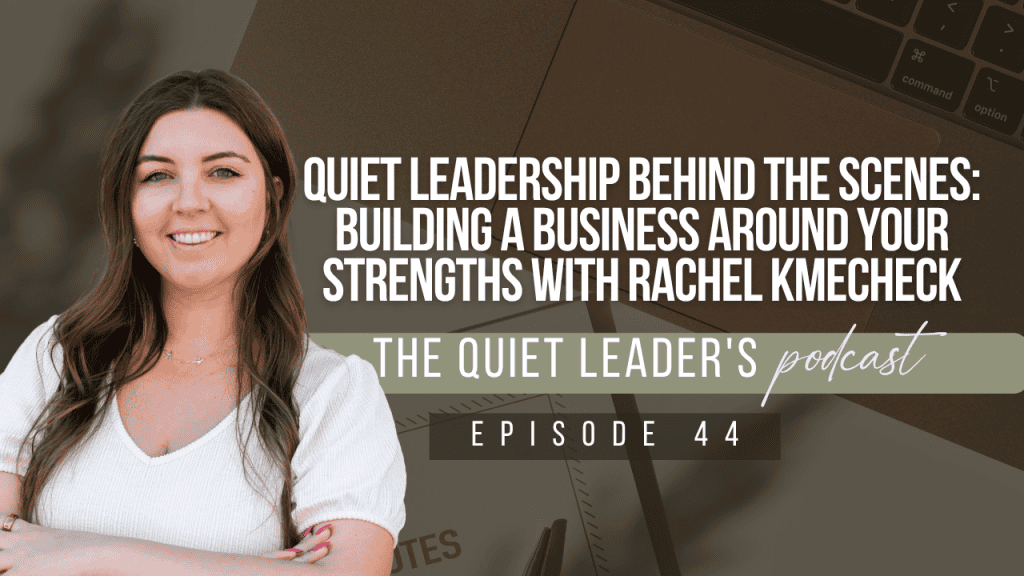
Rachel is a multipassionate entrepreneur, creative strategist, and artist. Through Rachel’s Creative Boutique, she works behind the scenes with small businesses and entrepreneurs to manage the technical details, systems, emails, websites, courses, and content that bring their ideas to life.
At the same time, she runs Modern Medieval Press, where she creates medieval-inspired artwork influenced by historic techniques, architecture, folklore, and storytelling.
In this episode of The Quiet Leader’s Podcast, Rachel joined me to talk about her journey into entrepreneurship, the systems that allow her businesses to work together, and what she’s learned about quiet leadership, long-term client partnerships, and playing to your strengths.
Sometimes Entrepreneurship Starts With a Catalyst
Like so many entrepreneurs, Rachel’s business journey started during COVID.
While still working a full-time job, she found herself with unexpected time to explore medieval manuscripts that were becoming digitized. As someone with a background in graphic design, she became fascinated by the artwork, details, and creativity she discovered.
Around the same time, she was approached to help create worksheets for an educational class.
Without realizing it yet, she was laying the groundwork for two completely different businesses.
But it wasn’t until 2022 that Rachel experienced the catalyst that ultimately pushed her into full-time entrepreneurship.
Her dad had a heart attack just a few days before Easter. When Rachel told her boss what was happening and that she couldn’t work, she was told she needed to because too many other employees had already taken time off.
It became one of those moments that makes you reconsider what you actually want your life to look like.
Rachel began finding more clients, and by September, she was ready. She put in her two weeks’ notice and became a full-time entrepreneur.
Sometimes we start a business because we’ve carefully mapped out every step.
And sometimes something happens that makes us realize we don’t want to keep building our lives around someone else’s rules.
Building a Business Around the Life You Want
Today, Rachel isn’t just running one business. She’s balancing two.
At first glance, Integrator work and medieval-inspired artwork might not seem to have much in common. But Rachel has found a rhythm that allows both businesses to coexist.
Part of that comes from recognizing the natural seasons of each business.
During the summer, Rachel spends more time attending in-person shows for Modern Medieval Press. At the same time, many of her Integrator clients naturally slow down during the summer months.
That doesn’t mean everything is always perfectly balanced. There are still moments when everything seems to happen at once.
But instead of expecting every week or every month to look exactly the same, Rachel allows her businesses to ebb and flow.
That’s one of the biggest opportunities we have as entrepreneurs: we can create businesses that work with our lives instead of constantly forcing our lives to work around our businesses.
Systems Don’t Have to Restrict You
Rachel’s ability to balance multiple businesses also comes back to one of her natural strengths: systems.
She first began experimenting with systems and automation inside her own art business. As she learned what was possible, that skill naturally carried into her client work.
And this is where systems can get misunderstood.
Systems aren’t necessarily about creating more rules or making a business rigid.
The right systems make things easier.
They remove unnecessary manual work. They reduce the opportunity for human error. They improve the customer experience. And they give everyone involved more time to focus on the work that actually requires their attention.
For creative entrepreneurs especially, that can mean spending less time behind a computer managing repetitive tasks and more time actually creating.
The Shift From Completing Tasks to Leading Behind the Scenes
One of the biggest shifts in Rachel’s business happened while working with a client who initially described the role as relatively simple.
At the time, Rachel still considered herself a virtual assistant. She expected to upload and download videos, schedule replays, and complete the tasks she had been assigned.
Then she got inside the business.
She started looking at the existing processes and immediately saw opportunities to make them better.
Why was someone waking up early just to manually send a text that could have been automated?
Why were people touching processes unnecessarily?
How could these systems be simplified so there was less room for human error and a better experience for the customer?
That is where the shift from task doer to strategic partner happens.
You’re no longer asking:
What do I need to complete?
You’re asking:
Why are we doing it this way? Is this actually necessary? How could we make it better? And how does this affect the business as a whole?
That’s leadership—even when nobody outside the business ever sees it.
Watch on YouTube
Your Unique Skills Are an Advantage
Rachel’s work is also a great example of why becoming an Integrator doesn’t mean fitting into one specific job description.
Yes, she understands systems, automations, emails, websites, and operations.
But she also brings her background in graphic design and her experience as an artist into her work.
That combination gives her a completely different perspective than another Integrator might have.
And that’s a good thing.
I often talk about each of us having our own tool belt. There will be overlap between our skills, but no two tool belts look exactly the same.
Some Integrators have a marketing background. Some understand ads. Some are incredible project managers. Some are highly technical. Others are especially strong with people and teams.
The goal isn’t to become everything to everyone.
It’s to understand what you are exceptionally good at and find clients who value those strengths.
For Rachel, being an artist also gives her a unique understanding of other creative entrepreneurs. She understands why an artist would rather be in the studio than spending hours managing a website, creating marketing systems, or uploading products.
Instead of separating those two parts of herself, she can use one to strengthen the other.
Let Your Business Evolve With You
Your business probably isn’t going to look the same three years from now as it does today.
Neither will your clients’ businesses.
That’s why Rachel believes it’s important to communicate with your clients about your own growth.
As you gain new skills, expand your expertise, or realize you want to work differently, you don’t necessarily have to leave your existing clients behind.
Talk to them.
Long-term client relationships can evolve as both businesses evolve.
Instead of simply saying, “I’m raising my prices,” you can have a larger conversation about the skills you’ve developed, what the client needs at this stage of their business, and how your partnership can change to support that growth.
That’s one of the biggest differences between transactional client work and a true strategic partnership.
You aren’t simply completing the same list of tasks indefinitely.
You’re growing together.
Play to Your Strengths
One of my favorite pieces of advice Rachel shared during our conversation was simple:
Play to your strengths.
You don’t have to be the end-all-be-all for your clients.
You don’t need to master every software, provide every service, or say yes to every request just because you technically could figure it out.
Instead, pay attention to what comes naturally to you.
What work do you genuinely enjoy?
What do clients consistently come to you for?
What can you see or understand inside a business that other people might miss?
What interests, experiences, or skills do you have outside of your traditional client work?
Those things aren’t distractions from your business. They may actually be what differentiates you.
The more you understand your strengths, the easier it becomes to find your role within a business and to find the clients who are actually aligned with the way you work.
Quiet Leadership Is Often About Discernment
Behind-the-scenes leadership isn’t always about doing more.
Sometimes, it’s about recognizing what doesn’t need to be done.
In operations especially, it’s easy for businesses to keep doing something simply because it’s always been done that way.
Processes get duplicated. Systems become overly complicated. Tasks get passed between multiple people unnecessarily.
A strong Integrator has the discernment to look at all of it and ask:
Do we actually need this?
That question might not look like leadership from the outside.
But when you can simplify a business, improve the client experience, free up the team’s capacity, and give the visionary more room to do what they do best, you’re creating an impact far beyond checking something off a task list.
That’s the power of quiet leadership.
And Rachel’s journey is a great reminder that you don’t have to choose between all the different parts of who you are to become a strong leader.
Sometimes, the very things that seem unrelated are exactly what make your approach so valuable.
Connect with Rachel:
www.rachelcreativeboutique.com
www.instagram.com/modernmedievalpress