What if building a successful business wasn’t about making more money, working more hours, or constantly chasing the next level of growth?
What if success meant having the flexibility to spend time with your family, working with clients you genuinely enjoy, and using your skills to make a meaningful impact?
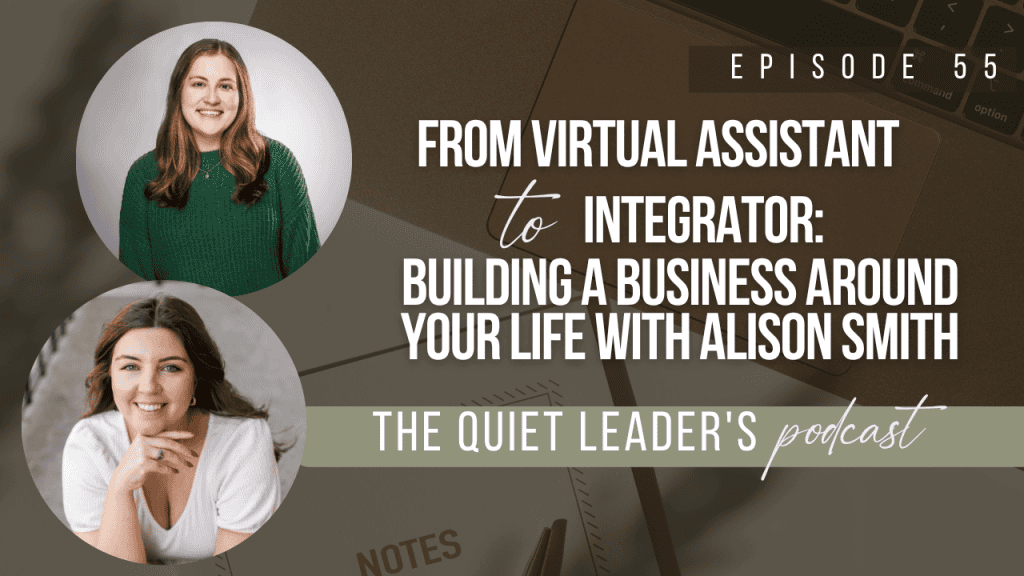
In this episode of The Quiet Leader’s Podcast, I sit down with Certified Integrator Alison Smith to talk about her journey from corporate project manager to virtual assistant to strategic Integrator.
Alison helps business owners in the health and wellness space build the systems and processes they need to grow while creating more space for life outside of work.
Her story is a powerful reminder that you don’t have to follow someone else’s definition of success. You can build a business that aligns with your priorities, supports your current season of life, and allows you to grow into the leader you’re meant to be.
Taking the Leap from Corporate to Entrepreneurship
Like many entrepreneurs, Alison didn’t originally plan to start her own business.
After earning her business degree, she followed the traditional corporate path and landed a project management position with a large healthcare organization.
She enjoyed her job, loved her team, and had the flexibility to work remotely.
But everything changed when she became pregnant with her daughter.
Suddenly, she started questioning what she wanted her life to look like after becoming a mom. She knew she wanted to spend as much time with her daughter as possible, but her family also needed her to contribute financially.
While still pregnant and working full-time, Alison discovered the world of freelancing and began laying the foundation for a virtual assistant business.
When her maternity leave ended, she made the decision not to return to her corporate position.
And here’s the part that makes her story even more interesting.
She didn’t have a single client lined up.
She had no guarantee that her business would work. In fact, she wasn’t entirely convinced that freelancing was a viable option until she landed her first client.
It took about a month to secure that first opportunity, and within four months, she was fully booked with virtual assistant clients.
Her experience is a reminder that you don’t always need to have everything figured out before taking action.
Sometimes, you build confidence by doing the thing you’re not entirely sure you can do.
Building a Business That Supports Your Life
One of my favorite parts of our conversation was hearing how intentional Alison is about designing her business around her family.
With an almost two-year-old daughter at home, her schedule looks very different from someone working a traditional 40-hour week.
She has a babysitter come to her home for six to nine hours each week, depending on the week, and uses that time along with her daughter’s naps to complete client work.
Occasionally, she’ll work in the evenings when necessary, but she’s intentional about limiting that.
And while she recognizes that she could grow her business and earn more money, that’s not her priority right now.
Her priority is being present with her daughter while bringing in enough income to support her family’s lifestyle.
This is something I deeply relate to.
When I started my business, I was also intentional about building it around my children. I knew those early years wouldn’t last forever, and I wanted the flexibility to be present while still contributing financially.
We often hear about entrepreneurs scaling to six or seven figures, building teams, and constantly pushing for more.
But what if that’s not what you want right now?
What if your version of success is working fewer hours, earning a comfortable income, and having the freedom to enjoy your life?
There’s nothing wrong with having ambitious revenue goals. But there’s also nothing wrong with choosing a business model that supports your priorities in your current season.
You get to define what success looks like for you.
Why Client Boundaries Are Essential for Sustainable Growth
As Alison’s business grew, she learned an important lesson about working with clients.
Not every client is the right client.
Early in her business, she worked with a visionary who frequently communicated new ideas, had limited structure, and created an environment that left Alison feeling anxious whenever a message came through.
After about three months, she realized the relationship wasn’t sustainable.
That experience changed how she approached client relationships moving forward.
Today, Alison is intentional about establishing communication boundaries, setting expectations around response times, and asking questions during discovery calls to determine whether a potential client is a good fit.
She looks for business owners who are financially ready to invest in support, responsive, respectful of boundaries, and willing to participate in improving their businesses.
She also prioritizes working with mission-driven entrepreneurs in the health and wellness space.
This is such an important part of building an aligned business.
As Integrators, we work closely with visionaries. We’re not simply completing a list of tasks. We’re stepping into their businesses as strategic partners.
That requires trust, communication, and a willingness to work together.
And sometimes, even when someone is a wonderful person, they might not be the right fit for your business.
One of the biggest indicators of alignment is how you feel when you’re working with someone.
Do you feel energized and excited to contribute? Or do you constantly feel overwhelmed and anxious?
Paying attention to those experiences can help you make better decisions about the clients you choose to work with.
The Shift from Task Doer to Strategic Integrator
Alison originally started her business as a virtual assistant, but it didn’t take long for her to realize she was bringing more value to her clients than her hourly rate reflected.
With her background in project management, she naturally started identifying opportunities for improvement, managing complex projects, and thinking strategically about her clients’ businesses.
One experience in particular helped her recognize that she was already operating as an Integrator.
A client was preparing to rebrand and relaunch an online course.
There were numerous moving pieces, a tight timeline, and no clear plan for how everything would come together.
Alison recognized that if someone didn’t take ownership of the planning and implementation, the launch wasn’t going to happen successfully.
So she stepped in.
She created the launch plan, organized the moving pieces, and followed through to ensure everything was executed on time.
That was when she realized she wasn’t simply supporting the business anymore.
She was leading it behind the scenes.
This is one of the biggest differences between a task doer and a strategic Integrator.
A task doer waits for direction and completes assigned work.
An Integrator looks at the bigger picture, identifies what needs to happen, and proactively takes ownership of moving the business forward.
And oftentimes, that leadership happens without anyone else realizing how much work is taking place.
Alison shared how she frequently identifies and resolves problems before her clients even know something is wrong.
She’s constantly thinking through how different systems, processes, and projects connect so that the business continues running smoothly.
That’s the value of an Integrator.
We’re the people connecting the pieces, keeping everything aligned, and helping visionaries bring their ideas to life.
Watch on YouTube
Owning Your Identity as a Leader
Another important part of Alison’s journey was the internal shift that happened when she started identifying herself as an Integrator.
For a while, she knew she was doing more than traditional virtual assistant work, but she wasn’t sure how to describe her role.
After completing the Molly Mariss Integrators® Certification Program, she began confidently introducing herself as an Integrator.
And that simple shift changed how she viewed herself and the value she brought to her clients.
She stopped underselling her expertise.
She recognized that she wasn’t just someone who could complete tasks or manage projects.
She was someone who could provide strategic direction, solve problems, and help business owners operate more effectively.
This is something I talk about frequently because so many behind-the-scenes leaders struggle to recognize their own value.
You might already be functioning as an Integrator without giving yourself permission to own that role.
Maybe your clients regularly ask for your opinion.
Maybe you’re the person identifying problems and recommending solutions.
Maybe you’re the one keeping projects moving forward and ensuring the team stays aligned.
Those are all examples of leadership.
You don’t need to be the face of a business to be a leader within it.
And sometimes, the biggest transformation happens when you finally recognize the expertise you’ve already developed.
Sometimes Growth Requires Letting Go
Toward the end of our conversation, Alison shared one of her biggest pieces of advice for other quiet leaders navigating growth.
Don’t be afraid to let go of clients who no longer align with where you’re going.
She recently made the decision to step away from one of her original virtual assistant clients.
It wasn’t because the relationship was difficult.
In fact, she loved working with this client and had an incredibly positive experience.
But as her business evolved, Alison recognized that she was at capacity.
If she wanted to bring on more strategic Integrator clients, she needed to create space, and that meant letting go of a stable, familiar client relationship.
When she shared her decision, the client was completely understanding.
But something unexpected happened.
The client actually expressed interest in reconnecting in the future to explore what a higher level of support might look like.
By stepping away from a role that no longer aligned with her business direction, Alison potentially opened the door to an entirely new opportunity.
This is something I’ve experienced in my own business as well.
It can feel scary to release a client, especially when that income has become familiar and dependable.
But when you’re operating at capacity, there’s very little room for something new.
Sometimes, creating space is exactly what allows you to grow, and letting go doesn’t always mean ending a relationship permanently.
It might simply mean allowing that relationship to evolve into something better aligned with the value you now provide.
Build a Business That Reflects Your Priorities
Alison’s story is such a great example of what happens when you intentionally build a business around your life rather than trying to fit your life around your business.
She didn’t start with a perfect plan.
She didn’t have clients waiting when she left her corporate job.
And she didn’t immediately recognize herself as a strategic leader.
Instead, she took action, learned through experience, established boundaries, and gradually stepped into a role that better reflected her skills and expertise.
Today, she’s building a business that allows her to spend time with her daughter, support mission-driven entrepreneurs, and provide meaningful strategic leadership behind the scenes.
And that’s what I want more quiet leaders to recognize.
You don’t have to chase someone else’s version of success.
You don’t have to work with every client who comes your way.
And you don’t have to stay in a role you’ve outgrown simply because it’s familiar.
You can create a business that supports your life, honors your capacity, and allows you to lead in a way that feels natural to you.
Listen to the Full Episode
Want to hear more about Alison’s journey from virtual assistant to Certified Integrator, including how she structures her workweek, evaluates potential clients, and navigates growth?
Tune in to this episode of The Quiet Leader’s Podcast for the full conversation.
Listen to the episode on your favorite podcast platform or watch the conversation on YouTube.
Connect with Alison Smith
Alison helps business owners in the health and wellness space build the systems and processes they need to grow while creating more space for life outside of work.
She’s also beginning to offer one-time strategic planning sessions for visionary business owners.
To learn more about Alison and her services, connect with her at Allison.smith.virtual@gmail.com.