There’s a specific season many business owners find themselves in that’s hard to name.
From the outside, everything looks fine. The business is running. Offers exist. Clients are being served. Momentum should be there.
But internally, it feels heavier than it should.
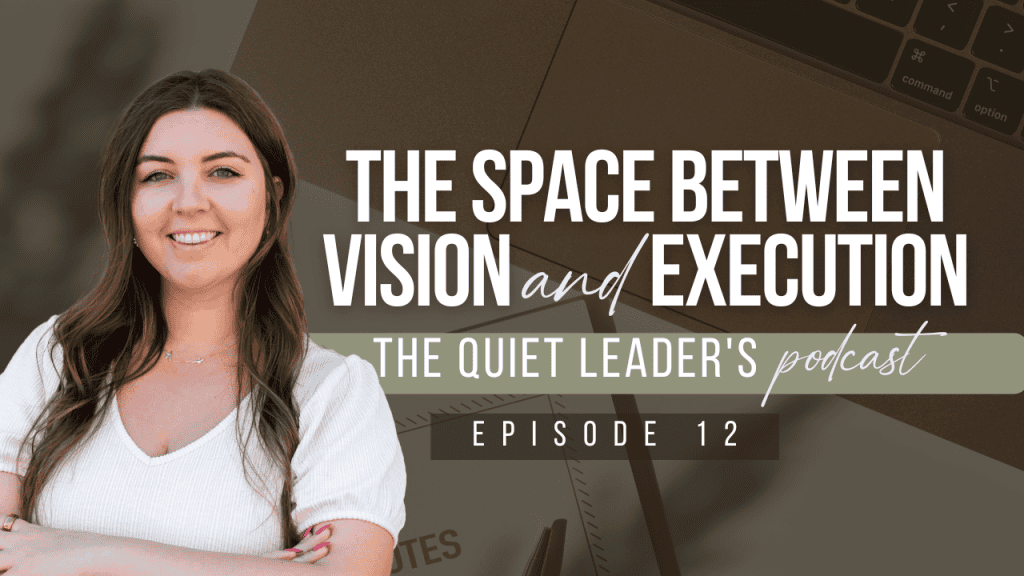
In a recent episode of The Quiet Leader’s Podcast, I spoke directly to two people at once: the visionary who feels this weight and the integrator, operator, or behind-the-scenes leader who supports them but struggles to explain what’s really happening beneath the surface.
What sits between them is something I call the support gap.
The Real Reason Visionaries Feel Stuck
Most visionaries don’t struggle because they lack ideas.
They struggle because they’re holding everything.
The future of the business.
The direction.
The ideas.
The people.
The decisions.
They’re not just doing tasks, they’re holding context.
Over time, this creates a quiet accumulation:
- Decisions that haven’t been made yet
- Ideas they don’t want to lose
- Systems that only exist in their head
- Plans that feel half-formed
- Simplification they know they need but don’t know where to start
Externally, they may look capable, successful, even impressive.
Internally, the thought is often:
“I’m tired of being the only one who sees the whole picture.”
This isn’t a motivation issue.
It isn’t a discipline issue.
It’s a support issue.
Why “More” Isn’t the Answer
When things start to feel heavy, most advice pushes visionaries toward doing more:
- Buy another course
- Add another strategy
- Tweak the offer again
- Post more content
- Push harder
But most of the time, visionaries don’t need more information.
They need:
- Clarity
- Reflection
- Prioritization
- Someone to help them decide what not to do
This is where the integrator lens becomes powerful.
What the Integrator Lens Really Is
If you’re an integrator listening, this matters:
Your value is not in having all the answers.
Your value is in helping visionaries filter.
The integrator lens sounds like:
- “This doesn’t need to happen all at once.”
- “This is actually the bottleneck.”
- “What’s the simplest next step?”
- “What matters right now and what can wait?”
Without this lens, visionaries often:
- Overcomplicate
- Delay decisions
- Get stuck in planning
- Swing between urgency and avoidance
With it, things calm down. Decisions get cleaner. Momentum returns.
Not because they’re doing more, but because they’re finally doing the right things.
What Momentum Taught Me About Real Support
For the past year, I ran a program called Momentum.
It started as a light-touch membership… templates, guidance, an “integrator in your back pocket.” Over time, it evolved into deeper, more personal support.
What surprised me most?
The biggest breakthroughs didn’t come from more content, frameworks, or group dynamics.
They came from:
- Consistency
- Context
- Relationship
- Accountability over time
One participant grew her business by 60%, not by rebuilding everything, but by returning to the same grounded questions again and again:
- What’s actually working?
- What’s draining you right now?
- What matters most in this season?
- What can wait?
Visionaries don’t need more access.
They need consistent, contextual support.
Watch on YouTube
Seven Ways Support Creates Momentum
Here’s what actually moved the needle inside Momentum:
1. Accountability Without Pressure
Each check-in followed the same rhythm:
- Wins since last time
- Current challenges
- Goals for the next meeting
This simple structure builds evidence, creates clarity, and removes the vague feeling of being “behind.”
2. Planning Without Perfection
Many visionaries avoid planning because they fear it will trap them.
We reframed planning as direction, not restriction.
You don’t need the perfect plan.
You need a plan you’ll actually use.
Good planning creates relief, not control.
3. You Don’t Need the “How” Yet
Visionaries often jump straight to tools, platforms, and logistics.
But clarity comes first.
Before asking how, you need to decide:
- Does this idea light me up?
- Does it make sense right now?
Execution comes second.
4. Visibility Through Clarity
Visibility issues aren’t about not knowing what to say, they’re about trying to say everything.
We simplified:
- What you do
- Who you help
- What problem you solve
- What you want people to do next
When clarity exists, visibility becomes easier.
5. Pricing, Growth & Nervous System Leadership
Growth is uncomfortable.
Raising prices is uncomfortable.
Being seen is uncomfortable.
Momentum is where we normalize that discomfort and learn how to lead ourselves through it instead of avoiding it.
6. Boundaries for Visionaries Who Care
Caring deeply can lead to overgiving, overextending, and resentment.
You can:
- Love your clients and have boundaries
- Be generous without self-sacrifice
- Grow without depletion
Sustainability requires protection of energy.
7. The 20% That Actually Matters
Every conversation returned to one question:
What is the 20% that matters right now?
Not later.
Not someday.
Right now.
Fewer priorities. Cleaner decisions. Less noise. More follow-through.
A Message for Integrators
This is the work.
Not just systems.
Not just execution.
Not just task management.
It’s holding space for clarity.
Helping visionaries slow down enough to decide.
Translating vision into priorities.
Reducing cognitive load.
When you can articulate what you create, not just what you do, your confidence grows, your marketing gets clearer, and the right clients recognize themselves in your work.
What Visionaries Actually Need
Visionaries don’t need more information.
They don’t need more pressure.
They need better support.
If this season feels familiar, you’re not broken, and you’re not behind.
You may simply be ready for a different kind of support.
And that shift changes everything.